With you, WashU improves the well-being of people and the planet through our new School of Public Health and interdisciplinary scholarship that combines environmental and population health science.
Alumni couple makes landmark gift to advance Bursky School of Public Health
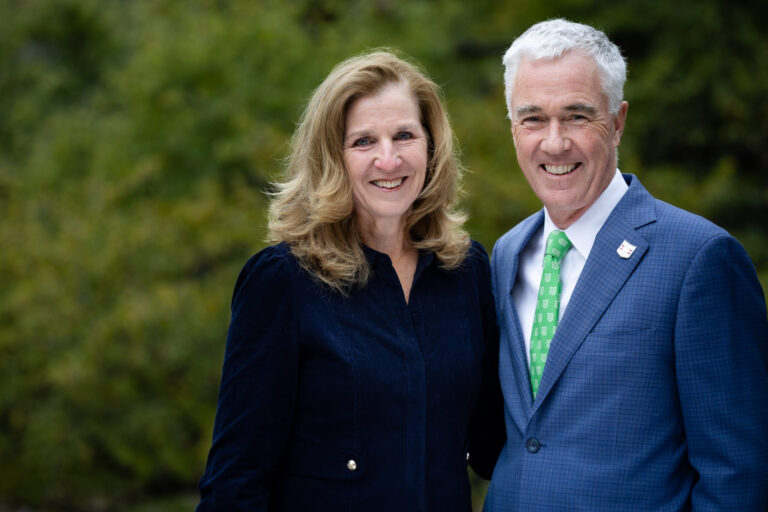
Andy Bursky, AB ’78, BS ’78, MS ’78, and his wife, Jane Bursky, AB ’78, have committed $200 million to accelerate innovation and real-world impact at the new WashU Bursky School of Public Health. Through support for novel research infrastructure, scholarships, and field-leading faculty, their historic gift builds on lessons learned from the coronavirus pandemic and seizes a critical inflection point for public health worldwide.
Slide
“My time at WashU helped me synthesize so many different skills, and that influences my approach today. It is bedside manner meets hard data — a synthesis that is critical to all work in public health.”
“By designing techniques capable of detecting patterns or correlations or structural relationships in seemingly random, stochastic data, I can try to ascertain how environmental factors might shape human health outcomes. Is weather related to Western Nile virus outbreaks? Does pollution affect the birth weight? Could long-term exposures play a role in aging or even Alzheimer’s disease? The answers to those questions can guide interventions.”
_
Bo Li
Stanley A. Sawyer Professor of Statistics & Data Science
“The classes at Brown School really broadened my perspective on social work and its many career paths beyond direct practice and counseling. Social work prepares you for so much—human resources, management, leading a nonprofit or national organization, even working in tribal government or museums.”
_
Kerry Bird, MSW ’98
Director of the North Carolina American Indian Heritage Commission
“My vision for the future is that your ZIP code will not be a strong predictor for your health outcomes — a future where a baby born in any neighborhood has a fair opportunity to be well.”
_
Doneisha Bohannon, MPH ’14
Director of Community Health Initiatives,
BJC HealthCare
“About 15 to 20% of our locations are in traditional food deserts. It’s just an integral part of our business model: to lower the cost of serving healthy food. There is real value in putting our fridges into places where there are not a lot of other options. There’s business value and public health value.”
“What excites me is that I’m contributing to a larger movement toward global justice and gender justice. We’re helping leaders in other countries gain knowledge and training to advocate for the needs they recognize in their own communities.”
Cultivating thriving communities requires a multi-pronged approach. While our pathbreaking neuroengineering program leverages innovation to address mental health issues, neurodegeneration, and more, scientists in Arts & Sciences are increasing food security and expanding biodiversity. With you, we can find novel, scalable solutions that allow everyone to live full, rich lives.